Mission and Goals —————————————————————
Thomas Armstrong, Ph.D.
Executive Director
"So much of what goes on in our society works to pressure people into meeting rigid expectations for behavior, learning, and development. The reality, though, is that individuals grow and learn in remarkably different ways. When we allow people to develop according to their natural rhythms, and learn in their own unique way, we make it possible for them to achieve a sense of meaning in their lives, and enable them to share their remarkable gifts with the broader culture, thus making the world a better place in which to live.''
The American Institute for Learning and Human Development is dedicated to cultivating this vision by advocating for developmentally appropriate practices and rich learning environments in education and parenting. It seeks to accomplish this mission by providing timely, practical, and cutting-edge information to educators and parents through the medium of conference presentations, professional development workshops, and training programs, as well as through the dissemination of books, articles, videos, and postings via a broad range of social media channels. The Institute strives to become a significant voice in education articulating the need for people of all ages to learn, grow, and thrive in a wide diversity of ways.
Neurodiversity
Over the past 10 years, the concept of neurodiversity
has emerged from the disability community to become a major
force in the understanding of individuals with brain differences,
including those with autism, ADHD, dyslexia, and intellectual
disabilities. Just as we speak of the benefits of biodiversity
and cultural diversity, so too, we need to appreciate the strengths
of those with mental health labels. Dr. Armstrong is one
of the key voices currently articulating a neurodiversity perspective
on human growth and learning.
Learn More...
Multiple Intelligences
Harvard professor Howard Gardner has suggested that the idea
of a single intelligence, or “I.Q.” is far too limited, and
that eight different intelligences need to be considered in
any accounting of an individual’s full potential. Dr.
Armstrong has been the leading figure in the world in translating
Gardner’s theory into practical applications for children, parents,
teachers, and adult learners.
Learn More...
Awakening Natural Genius
Every child comes into life as a genius, full of creativity,
wonder, playfulness, and wisdom. Dr. Armstrong has been
a major advocate for the child as a natural genius, and in his
books and speaking engagements has articulated twelve qualities
of genius, three factors that shut the genius down, and five
ways to reawaken the genius in both children and adults.
Learn More...
Miseducation in America
The push for higher academic achievement as measured on
standardized tests has created a crisis in education where
teachers are forced to cheat to boost test scores,
stressed-out students take performance drugs to study
harder, and policy makers narrow the curriculum to emphasize
reading, math, and science to the detriment of the arts,
history, social science, physical education, and vocational
training. Dr. Armstrong is a strong critic of these trends
and seeks to change the educational discourse by arguing for
the development of the whole child and a focus on key
developmental goals for early childhood education,
elementary school, middle school, and high school.
Learn More...
Non-Drug Alternatives for ADHD
ADD/ADHD is one of the most common mental disorders in children
and adolescents. Dr. Armstrong has been a vocal critic of this
medical diagnosis, believing that other factors including developmental,
educational, and creative factors need to be taken into account
before a diagnosis is made. He proposes fifty non-drug strategies
to improve behavior and attention span, to be used in addition
to, or instead of, traditional medical interventions.
Learn More...
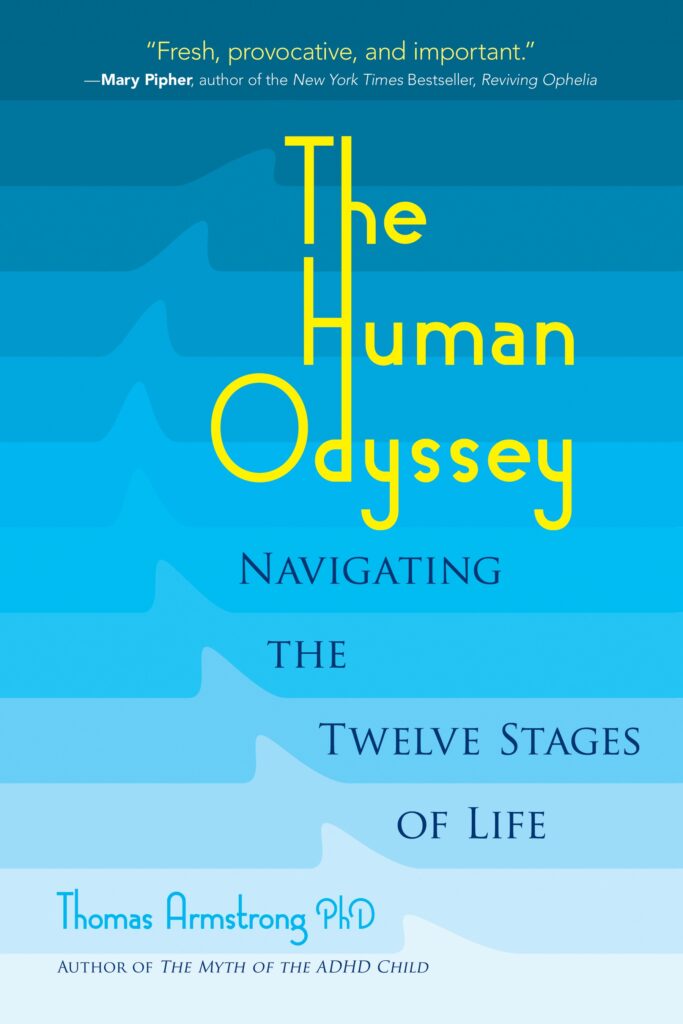
The Stages of Life
Each of us is on a unique journey through life that encompasses
many significant crossroads and pathways. In his book
The Human Odyssey, Dr. Armstrong synthesizes a wide range of
material from anthropology, sociology, psychology, literature,
religion, and brain research to articulate a model of human
development that encompasses twelve different stages, each with
its own unique gift to humanity. In The Best Schools,
he applies many of these insights to education.
Learn More...